
November 4, 2026
Selling a Mid-Century Modern Home in Scottsdale — Character Sells
Selling a mid-century modern home in Scottsdale? See what buyers pay for in 85251 and 85257, how to price original character, and what a 1% listing fee saves.
Seller Guides · 15 Min Read
Selling a Mid-Century Home in South Scottsdale — Character Sells
Selling a mid-century home in Scottsdale is a different exercise from selling a newer house — the buyers who pay most for a South Scottsdale ranch are shopping for architecture, lot, and walkability, and the sale is won by pricing that character correctly and putting it in front of them.
Key Takeaways
- South Scottsdale — the 85251 and 85257 ZIP codes around Old Town Scottsdale — holds the city's largest concentration of postwar ranch and mid-century homes, including two of Scottsdale's four historic districts.
- Buyers pay for intact architecture, sound systems, a usable lot, and proximity to Old Town Scottsdale and the Indian Bend Wash greenbelt. They discount updates that erase the original design.
- Character homes price best against true architectural comparables, not the nearest ZIP-code median. Original, renovated, and rebuilt homes trade as three different products on the same street.
- In a historic district, interiors may be changed freely, but exterior alterations go through the city's Historic Preservation Office. Buyers should know that before they write an offer.
- Our listing fee is 1% of the sale price with a $5,500 minimum. Near the 85251 median of $629,728, that is $6,297 rather than $18,892 at 3% — $12,595 kept. No upfront costs. Brokered by HomeSmart.
Selling a mid-century home in Scottsdale starts with the inventory
South Scottsdale is where the city grew up. Much of the land between Chaparral Road and the Tempe line was citrus groves and farmland until the postwar building boom, and by the early 1960s it had been filled with block-built ranch homes on generous lots, carports facing the street, and floor plans designed for a desert that had only recently discovered air conditioning. Most of that housing is still standing. That is the starting point for anyone selling here: your competition is not the new construction in North Scottsdale. It is the house three doors down, built by the same builder, in the same year, and remodeled — or not — by four different owners since.
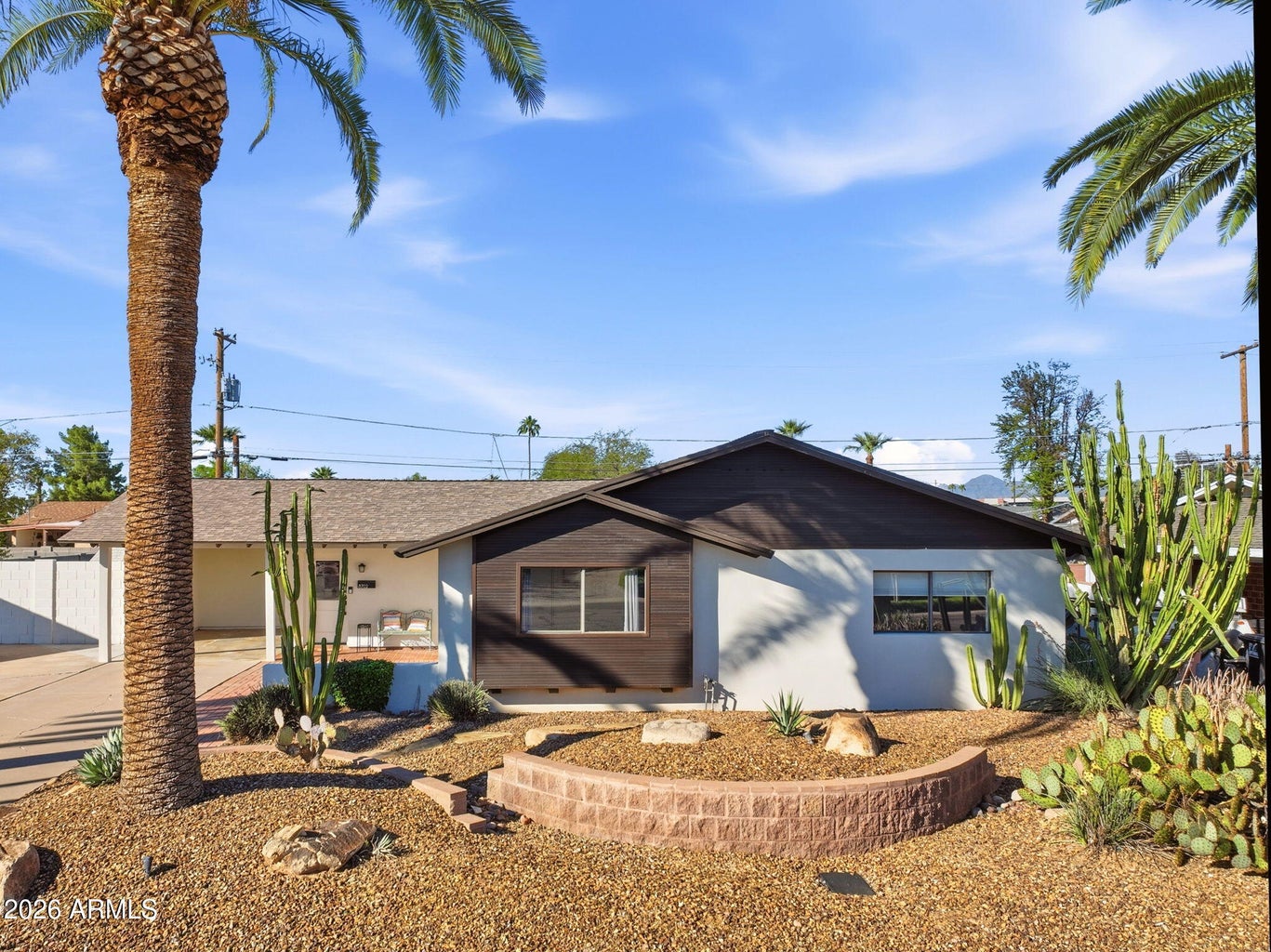
The inventory falls into three broad types. The postwar ranch is the most common: a single-story, block or brick home of modest size, low-pitched roof, modest windows facing the street, and a backyard sized for a pool. The architect-designed mid-century modern is rarer and more sought after — low gables, clerestory and floor-to-ceiling glass, open plans, and the indoor-outdoor flow that defined desert modernism. The infill home is newer: a scrape-and-rebuild or a down-to-the-studs reconstruction on an original lot, often styled to echo the neighborhood's mid-century roots while delivering contemporary square footage.
Two neighborhoods carry the city's formal recognition. Town & Country Scottsdale is a small enclave of 62 homes designed by architect Ralph Haver, known for clinker-brick facades and front-facing gables; it was designated historic by the City of Scottsdale and is listed on the National Register of Historic Places. Village Grove, a much larger postwar neighborhood of Allied-built ranch homes near the Indian Bend Wash greenbelt, has its first six units designated as a city historic district. The City of Scottsdale's Historic Preservation Program lists four historic districts in all, and both South Scottsdale neighborhoods are among them.
Around those districts are dozens of unrecognized subdivisions with the same bones and the same buyer appeal. Whether your home sits inside a district or a block outside one, the selling strategy rests on the same idea. Character is an asset when it is presented, priced, and marketed as one — and a liability when it is treated as an old house that needs explaining. Our pillar guide to selling your Scottsdale home for 1% and keeping more equity covers the citywide picture; this article is about the homes that do not fit the citywide template.
South Scottsdale sellers do not compete with new construction. They compete with the same floor plan, three doors down, remodeled four different ways.
Before you list, we pull the architectural comparables for your specific builder, era, and condition — not just the ZIP-code median — and show you where your home sits among them.
Ranch style home Scottsdale value: what buyers actually pay for
The buyers who pay the most for a South Scottsdale mid-century or ranch home tend to arrive with a clear picture of what they want. Some are design-focused buyers who have toured Haver and Allied homes before and know a period-correct window from a replacement. Others are relocating professionals who want a single-story home near Old Town Scottsdale with a yard and no stairs. A third group is renovation-minded: buyers looking for good bones on a good lot who plan to do the work themselves. Each group values different things, and the listing has to speak to the one most likely to pay your price.
Across all three, four factors carry most of the value. Original architecture that is intact. Clinker brick, exposed beams, original fireplaces, terrazzo floors, period cabinetry, and clerestory glass are what separate a character home from a dated one. Systems that are sound. A buyer who loves the architecture still wants a newer roof, updated electrical, modern plumbing, and efficient cooling, because those are the expensive, invisible fixes. The lot. Postwar lots in South Scottsdale are often larger than buyers expect, with mature shade trees, alley access, and room for a pool or casita. Location. Proximity to Old Town Scottsdale, the greenbelt, and the Papago Park corridor is a large part of why buyers choose this area over newer suburbs.
What buyers discount is just as instructive. A flip that replaced every original surface with builder-grade gray tends to read as an ordinary house on an expensive lot, and design-focused buyers often walk past it. Additions that break the roofline, replacement windows that change the proportions of the facade, and enclosed carports that alter the street view all narrow the buyer pool. The table below compares how each factor reads in an original, well-kept home and in a thoughtfully renovated one.
| Value factor | Original, well kept | Thoughtfully renovated | How buyers read it |
|---|---|---|---|
| Facade and roofline | Intact brick or block, original gables and carport | Original lines kept; paint and landscape refreshed | Intact lines widen the design-buyer pool; altered fronts narrow it |
| Windows and glass | Original steel or aluminum frames, single pane | Period-appropriate profiles, energy-efficient glass | Proportions matter more than the frame material |
| Kitchen | Original cabinetry and layout | Opened to living areas, period-sympathetic finishes | The largest single driver of buyer reaction in photos |
| Baths | Original tile, often in period colors | Updated plumbing and fixtures, original character echoed | Buyers accept modest size; they discount failing plumbing |
| Roof, electrical, plumbing | Often original or partially updated | Replaced or documented | Invisible to photos, decisive in inspection |
| Floors | Terrazzo or hardwood under carpet | Original floors restored where they exist | Restored terrazzo is a selling point; covered terrazzo is a surprise |
| Lot and outdoor space | Mature trees, grass, older pool | Shade kept, xeriscape added, pool resurfaced | Lot size and shade are hard to replicate in newer neighborhoods |
| Historic district status | Exterior changes need city review | Prior changes approved and documented | A clean approval history removes a buyer question |
Value factors reflect how character homes in 85251 and 85257 are commonly marketed and received. They are general guidance, not an appraisal; your home's specific comparables govern.
The pattern in the table is consistent. Renovations that respect the original design tend to widen the buyer pool. Renovations that erase it tend to narrow the pool to buyers who could have bought a newer house elsewhere — and who will compare your price to one.
Pricing and marketing a distinctive home to the right audience
A character home is harder to price than a tract home, and the reason is comparables. An automated valuation model sees a 1,600-square-foot, three-bedroom home built in 1959 in 85257 and averages it against other homes that match on paper. It cannot see that one is an intact Haver with a restored clinker-brick facade, another is an Allied ranch with original terrazzo, and a third was rebuilt down to the slab last year. Those three homes can sit on the same street and sell for very different prices. Using the ZIP-code median as a pricing anchor — as of 2026, roughly $595,000 in 85257 and $629,728 in 85251 — is useful context and a poor list price.
Good pricing for a character home sorts the comparables into tiers before it averages anything. Original-condition homes are compared with original-condition sales. Thoughtful renovations are compared with thoughtful renovations. Full rebuilds are compared with other rebuilds and with newer homes nearby. The architect and builder matter, because design-focused buyers search by both. And in a historic district, the comparables should come from inside the district where possible, because buyers there are paying for the designation as much as the house.
Marketing follows the same logic. The listing description should name what is there — the architect, the builder, the year, the original materials — because that is what design buyers search for. Photography should be shot to show architecture: the roofline at the right hour, the clerestory light, the line from the living room to the yard. Staging should be restrained and period-sympathetic rather than generic; our guide to home staging tips for Phoenix sellers explains how to get most of the return for less of the expense. And the disclosures should answer the questions a careful buyer will ask before they ask them — roof age, electrical panel, plumbing material, and, in a historic district, any exterior changes and the approvals behind them.
Pre-list work deserves the same discipline. In most South Scottsdale character homes, the best-spent dollars go to the items an inspector will flag and the items a camera will catch: roof, electrical safety, plumbing leaks, paint, landscape, and cleaning. The worst-spent dollars go to removing original features to make the home look newer. If you are unsure whether a fixture, a floor, or a wall is worth keeping, the answer is usually to keep it and let the buyer decide.
The ZIP-code median is context. The architect, the builder, and the condition tier are the price.
Interactive: the character-home savings calculator
Enter your expected sale price, or choose a South Scottsdale benchmark. The calculator applies our fee — 1% of the sale price with a $5,500 minimum, so the straight 1% rate takes effect at $550,000 and above — and compares it with a 3% listing fee. Add a pre-list refresh budget, and it shows how much of that work the difference would cover.
Character-Home Savings Calculator
Slide from $300,000 to $3M, or type any value above.
Roof, electrical, paint, landscape, or restoration work you plan before listing.
| Our listing fee — 1%, $5,500 minimum | — |
| Effective rate | — |
| Listing fee at 3% | — |
| Kept by the 1% fee | — |
Three cases show the range. At the 85257 benchmark of about $595,000, our fee is $5,950 against $17,850 at 3% — $11,900 kept. At the 85251 benchmark of $629,728, it is $6,297 against $18,892 — $12,595 kept, which would pay for half of a $25,000 pre-list refresh on its own. Below $550,000 the $5,500 minimum governs: a $450,000 sale carries a $5,500 fee, an effective rate of about 1.22%, against $13,500 at 3% — still $8,000 kept.
For a character home, that difference has a practical use. It is often the money that pays for the roof, the panel upgrade, or the terrazzo restoration that lets the home compete in the right tier — work that a seller paying a higher fee might skip.
A calculator uses the price you enter. We start from your home's tier of architectural comparables and build a written net sheet that shows the fee, the prep budget, and what you keep.
Local proof: the South Scottsdale 85251 seller and the 85257 seller
The two ZIP codes that make up most of South Scottsdale share an architectural history and differ in almost everything else. 85251 wraps around Old Town Scottsdale and reaches west toward the Phoenix line, where Arcadia-adjacent pockets draw buyers who want a mid-century home a short drive from Arcadia's dining corridor at a Scottsdale address. Its inventory is the most mixed in the city: original ranches, Haver-era homes, condominiums, patio homes, and a growing number of infill rebuilds. The campaign's Redfin benchmark puts the 85251 median at $629,728 as of 2026, and that figure blends every one of those product types.
85257 lies to the south and east, between the Indian Bend Wash greenbelt, the Papago Park corridor, and the Tempe line. It is where Town & Country and Village Grove sit, and its housing is more uniformly single-family postwar ranch. The campaign's Redfin benchmark puts the 85257 median near $595,000, the entry tier of single-family Scottsdale. Redfin's most recent three-month reads for both ZIP codes have stayed in the high-$500,000 to low-$600,000 range, which is why we treat any single month's median as context rather than a target.
| Benchmark | Median | Our fee | At 3% | Kept |
|---|---|---|---|---|
| South Scottsdale, 85257 | About $595,000 | $5,950 | $17,850 | $11,900 |
| Old Town Scottsdale, 85251 | $629,728 | $6,297 | $18,892 | $12,595 |
| Scottsdale citywide | $906,900 | $9,069 | $27,207 | $18,138 |
Source: Redfin ZIP-code and city housing market data, as of 2026, all home types; campaign benchmark figures held constant across the Scottsdale series. ZIP medians blend condominiums with single-family homes and describe areas, not houses. Fee figures are Python-verified with Math.max(price × 0.01, 5500) and exclude any compensation you choose to offer a buyer’s agent. Nothing here is an appraisal.
Read against the character-home market, those medians understate the spread. An original ranch needing systems work and a fully rebuilt infill home can sit on the same 85257 block and sell hundreds of thousands of dollars apart. Renovated, architecturally intact homes in Town & Country and Village Grove have been marketed well above the ZIP-code medians, because buyers are paying for the designation, the design, and the scarcity together. That is the case for tiered comparables: the median tells you where the market is, and the tier tells you where your home belongs within it.
What to look for in a low commission realtor South Scottsdale sellers can trust
Selling a character home well takes specific knowledge, and it is fair to test for it. Ask anyone you interview to identify your home's builder and era, and to name the comparables they would use. Ask how they would sort original, renovated, and rebuilt sales. Ask whether they know the review process for exterior changes in Scottsdale's historic districts, and how they would disclose prior work. Ask how the photography will be shot, and who will write the listing description. And ask who will actually negotiate your contract — the person in front of you, or someone you have not met.
Ask, too, how compensation for the buyer's agent will be handled, because it belongs on the same net sheet as the listing fee. Since the practice changes of August 2024, sellers still have the choice of offering compensation to buyer brokers, and are not required to. Any amount is negotiable. Some sellers offer it, or agree to it in response to an offer, as a deliberate choice; others do not. Either is legitimate when it is made with the numbers in front of you.
The work of selling a character home does not change with the percentage. What changes is how much of the sale you keep.
For our part: 22 years across the Phoenix metro, more than 3,000 homes sold, over $900M in closed transactions, and more than 500 five-star reviews. We are brokered by HomeSmart. Every listing receives professional photography and MLS syndication to Zillow, Realtor.com, Redfin, Homes.com, and more than 200 partner portals, and every character-home listing gets the tiered comparables, architecture-first marketing, and disclosure preparation described above. Our listing fee is 1% of the sale price with a $5,500 minimum, there are no upfront costs, and nothing is owed unless your home sells. Our seller services cover the full listing from pricing through closing. Full service. Honest pricing.
Questions about selling a mid-century or ranch home in South Scottsdale
Should I renovate my mid-century home before selling it
Usually not fully. The strongest returns tend to come from systems and presentation — roof, electrical safety, plumbing, paint, landscape, and cleaning — rather than a full remodel. Removing original features to make the home look newer often narrows the buyer pool. If a fixture or floor is original and in sound condition, keeping it is usually the better choice.
Does being in a Scottsdale historic district lower my home's value
Not inherently. Historic designation in Scottsdale governs exterior alterations and demolition, which the Historic Preservation Commission and Office review; interiors can be modified as owners choose. Many design-focused buyers seek out Town & Country and Village Grove precisely because the designation protects the street. The key is disclosure: buyers should understand the review process and see any prior approvals.
How is a ranch-style home in Scottsdale valued if there are few true comparables
By sorting sales into condition and design tiers before averaging. An original ranch is compared with original sales, a thoughtful renovation with other renovations, and a rebuild with rebuilds and newer homes nearby. Where comparables are thin, the builder, the architect, the lot, and the location within 85251 or 85257 carry more weight than square footage alone.
Do I have to offer compensation to the buyer's agent
No. Sellers are not required to offer or pay compensation to a buyer's agent, and any amount is fully negotiable. Some sellers choose to offer it, or agree to it in response to an offer; others do not. It is your decision, separate from our listing fee, and we model the options on your net sheet.
Does a 1% listing fee mean less marketing for a character home
No. The service is the same: tiered pricing, architecture-first photography, a researched listing description, disclosure preparation, negotiation, and management through closing. The fee is 1% of the sale price with a $5,500 minimum. Near the 85251 median of $629,728, that is $6,297 rather than $18,892 at 3% — $12,595 that stays with you.
1% Listing, No Gimmicks
Your home has character. Price it like it does.
A free consultation for South Scottsdale sellers: your home's tier of architectural comparables, the pre-list work worth doing and the work worth skipping, a marketing plan built for design-minded buyers, and your net at our 1% listing fee. No upfront costs, and nothing owed unless your home sells.
Get Your Free ConsultationSources and further reading: City of Scottsdale — Historic Preservation Program · National Park Service — Town and Country Scottsdale Residential Historic District · Redfin — 85251 housing market · Redfin — 85257 housing market · NAR — what the settlement means for home sellers.